Managing Models
Models can be configured per environment. These models only work if the related API Key is also entered (and working) for the environment.
Available Language Models
Currently, the following language models can be configured:
| Model | Provider | Recommended for |
|---|---|---|
| GPT 5.2 | OpenAI | General use, complex tasks |
| Claude Sonnet 4.5 | Anthropic | Long texts, analysis, code |
| Gemini 3 Pro | Multimodal, fast responses |
Image Models
| Model | Provider | Type |
|---|---|---|
| GPT-Image-1 | OpenAI | Image generation |
| DALL-E 3 | OpenAI | Image generation |
| SDXL | Stability AI | Image generation |
| SD3.5 | Stability AI | Image generation |
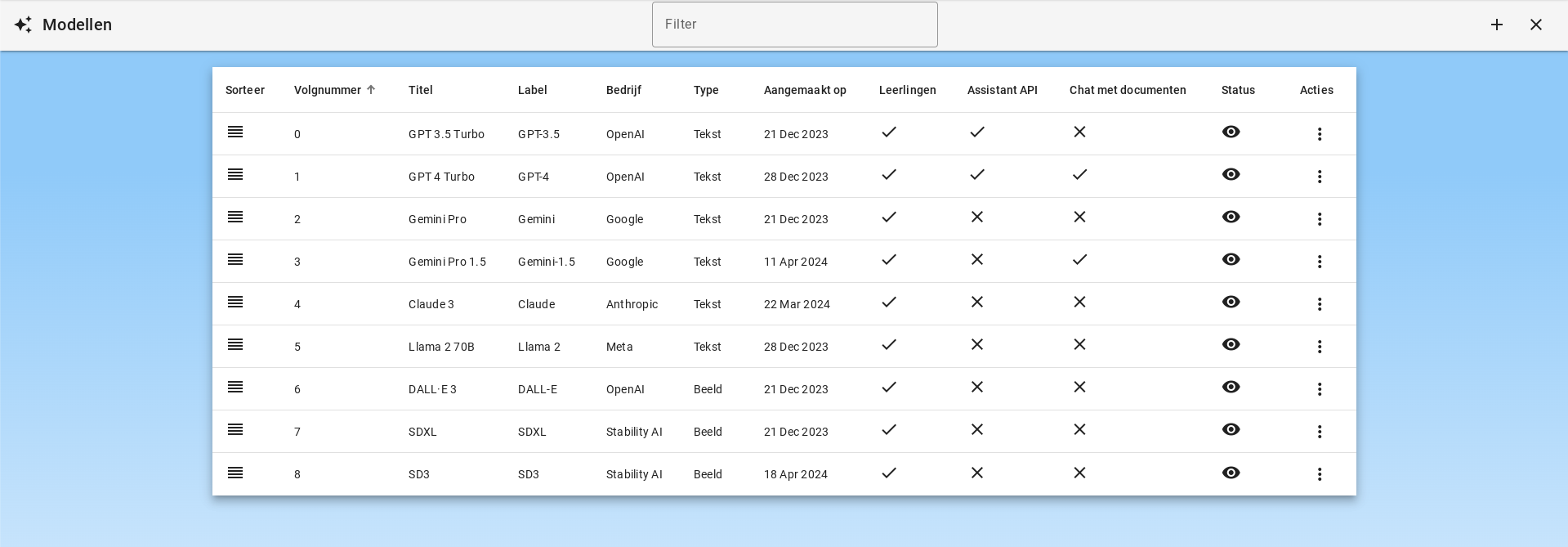
AI-School aims to implement newly available models as quickly as possible within the app. We will keep administrators informed as soon as new models can be implemented.
Model Settings
Models have the following settings:
| Setting | Description |
|---|---|
| Available for students | Yes/no - Determines if students can use this model |
| Available for Assistant API | Yes/no - Only for OpenAI language models |
| Available for document chat | Yes/no - Recommended: only advanced models with large context window |
| This is a thinking model | Yes/no - Enable to link a fast model |
| Fast model (alternative) | Select a faster model for default use |
Models can be ordered by dragging a row in the sorting column. This order is maintained when loading models.
Thinking Model Configuration
A powerful feature is linking a thinking model to a fast model. This allows users to:
- 🚀 Use a fast model by default - Cheaper and faster for most tasks
- 🧠 Switch to the thinking model - By clicking the "think" button for complex tasks
How Does It Work?
- Configure a thinking model: Check "This is a thinking model" on an advanced model (e.g., GPT 5.2)
- Select a fast model: Choose a faster alternative (e.g., GPT 4.1 Mini) from the dropdown menu
- User experience: Users see a 💡 icon in the chat to toggle between models
Benefits
| Benefit | Description |
|---|---|
| Cost savings | Fast models are cheaper per token |
| Faster responses | Smaller models respond faster |
| Flexibility | Users choose when to "think deeper" |
| Best of both worlds | Fast for simple questions, powerful for complex tasks |
Recommended Combinations
| Thinking Model | Fast Model | Suitable for |
|---|---|---|
| GPT 5.2 | GPT 4.1 Mini | General use |
| Claude Sonnet 4.5 | Claude Haiku 3.5 | Long texts, analysis |
| Gemini 3 Pro | Gemini 3 Flash | Multimodal tasks |
The fast model doesn't need to be from the same provider. For example, you can use GPT 5.2 as thinking model with Gemini Flash as fast model.
Azure OpenAI Models
In addition to standard OpenAI models, it is also possible to use Azure OpenAI models. This is useful for schools that already have an Azure subscription or have specific compliance requirements.
Requirements
To use Azure OpenAI, you must first enter the following details in the API Keys of your environment:
| Setting | Description |
|---|---|
| Azure OpenAI API Key | The API key from your Azure OpenAI resource |
| Azure OpenAI Instance Name | The name of your Azure OpenAI instance (e.g., my-school-openai) |
Adding a Model
When creating a new model:
- Click "New model"
- Enter
Azurein the Company field - An additional field appears automatically: Azure Deployment Name
- Enter the name of your Azure deployment (e.g.,
gpt-4oorgpt-35-turbo) - The Identifier can be the same as the deployment name
- Data residency: Your data stays within the Azure region of your choice
- Enterprise security: Integration with Azure Active Directory and network security
- Existing billing: Use your existing Azure subscription
- Compliance: Meets various compliance standards (ISO, SOC, HIPAA)
Help with Setup
AI-School will provide assistance in setting up the models. Sometimes model identifiers need to be adjusted because a new version of the model is available. We will communicate this and set it up in your environment if desired.
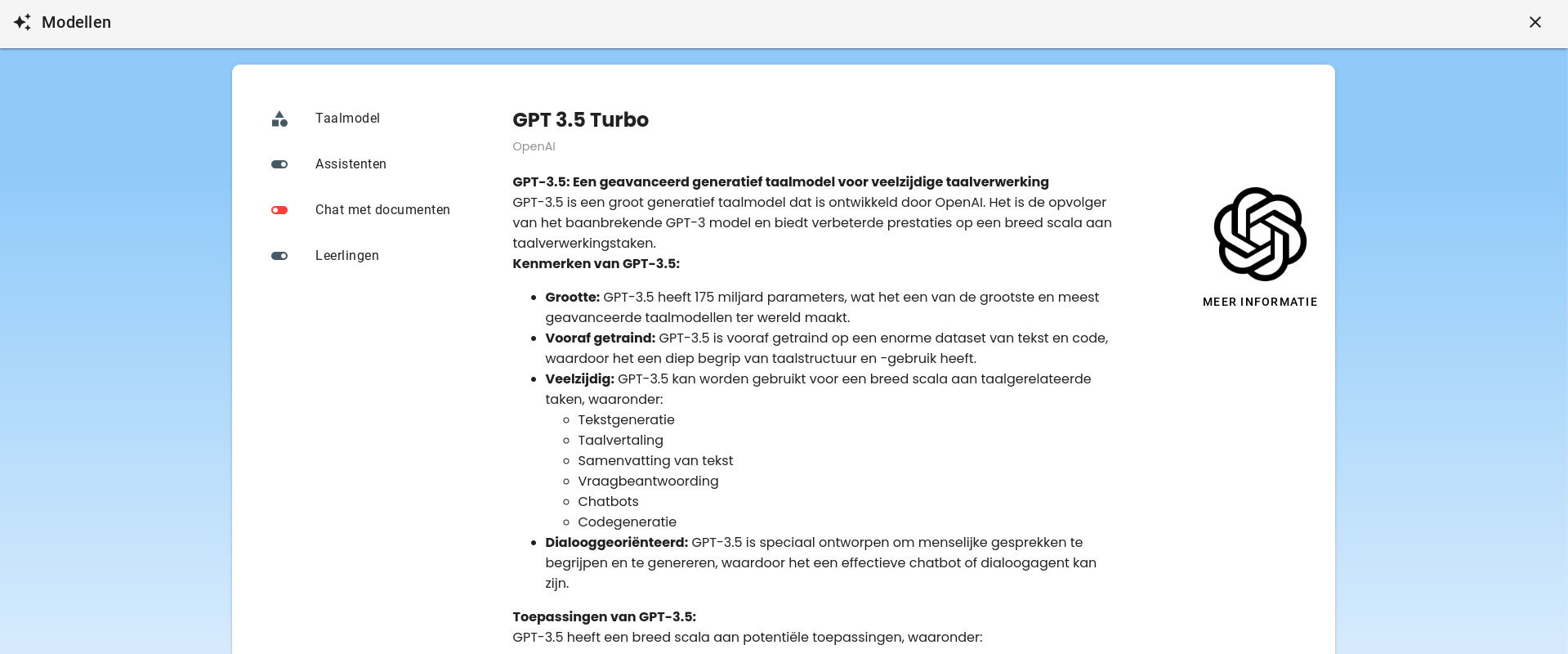
Model Overview Information
Outside the admin section, there is also an overview for staff and students of all available models. You can access this by clicking Preferences and then "Information".